
How & Why I Started Freelance Writing
I have always loved writing, but I did not grow up believing it could become a realistic career.
I was raised in post-communist Romania, at a time when the internet was either unavailable or only beginning to become part of everyday life. Writing was not presented as a practical profession. The assumption was that intelligent students should become engineers, doctors or lawyers. So I chose engineering.
That decision eventually took me through a bachelor’s degree, a master’s degree and a PhD in computer engineering. I then spent nine years working in academia as a researcher and teaching assistant.
If you’d have told 18-year-old me that after all that time I’d eventually become a writer, going back to my first and true passion, I would've laughed.
I began taking on writing projects alongside my academic work, initially because companies needed someone who could understand technical subjects and explain them clearly. One project led to another, and I slowly realised that writing did not need to remain a side interest.
In 2020, I finally left academia and became a full-time freelance writer.
Today, I work mostly on long-form content, blog posts, white papers and case studies for technology companies. I know from the outside it might look like I completely abandoned my education, but that’s not the case. I found a way to combine my technical background with my interest in writing.
University Years
“Growing up in post-communist Romania, writing was not presented as a realistic career choice.”
I studied computer engineering all the way through to a PhD.
I liked the topic, but I’d lie if I said the decision wasn’t partially influenced by the expectations of those around me.
At the time, writing did not seem like a stable profession, especially in Romania. The internet had not yet created the range of online writing, content marketing and remote-working opportunities that exist today.
The traditional message was clear: smart students became engineers, lawyers or doctors.
I was good at technical subjects, so engineering seemed like the sensible path. I completed my bachelor’s degree, continued with a master’s degree and then moved directly into a PhD program.
Although I would eventually leave academia, I do not regret studying engineering.
It gave me technical knowledge, taught me how to analyze difficult information and helped me become comfortable with complex subjects. Those are all skills I use in my writing today, particularly because many of my clients operate in technology-related industries.
Perhaps my education did not lead me towards the career I originally expected butt gave me the expertise that later helped me build a different one.
My First Jobs
Working in Academia
I began working officially as a teaching assistant and researcher when I started my PhD.
I remained in academia for nine years, teaching students, conducting research and participating in the wider publication process. My work involved both technical experimentation and the communication of research findings.
Academia can be intense. Producing meaningful research is only one part of the job. You also need to explain the work, defend its relevance and communicate the results to other people.
That meant preparing research papers, submitting articles to journals, attending conferences, contributing to books and eventually writing my thesis.
Although I was working in engineering, writing was present throughout the entire process.
Academic Research Brought Me Back to Writing
Engineering research requires tangible findings, but those findings do not speak for themselves.
They need to be organised, explained and presented convincingly. A researcher may have completed excellent technical work, but other people still need to understand why it matters.
This meant that a significant part of my academic career involved writing.
“Working in academia brought me back to writing because research only matters when you can communicate the results.”
I wrote articles for peer review, prepared conference submissions, and worked on longer academic publications. I needed to take complex technical information and structure it in a way that other researchers could follow.
In some ways, this is not entirely different from marketing.
You may have a strong product, a useful idea, or promising results, but you still need to communicate them effectively. The way you present the information influences whether people understand its value.
Academic writing therefore helped me rediscover my interest in language while developing skills that would later become useful in commercial content writing.
I learned how to research unfamiliar details, organise complicated arguments, support claims with evidence, and communicate with a specialised audience.
My First Commercial Writing Job Came Through My Technical Expertise
My transition into commercial writing began gradually while I was still working in academia.
Around 2016, a local company with headquarters in London contacted me. It was a startup applying for grants and needed someone who could combine technical knowledge with writing ability.
The team had seen my academic work and believed my background was adjacent to the area in which the company operated. They initially invited me to join part-time and help with grant applications.
After that, I began writing blog posts for the company.
This happened around the period when organisations were preparing for the introduction of the General Data Protection Regulation. GDPR officially became enforceable in 2018, but companies were already becoming increasingly concerned about compliance in 2016 and 2017.
We started producing content around that demand.
The blog eventually performed so well that some of its pages ranked above the European Commission for relevant searches. People began calling and emailing the company because they assumed that a website ranking above the Commission must be an official or highly authoritative resource.
That experience showed me how powerful useful content could be.
It also brought my work to the attention of other companies. People began asking who had written the content and helped the company achieve those rankings. Those enquiries eventually created more writing opportunities for me.
Why I Transitioned into Freelance Writing
I Wanted Greater Freedom After Years in Academia
“After spending so many years in academia, I wanted the freedom to choose my clients and the work I accepted.”
One of the main reasons I chose freelancing was freedom.
After spending years working within academic systems, I was tired of rules and restrictions. Academia often comes with established hierarchies, administrative requirements and limited control over how work is structured.
Freelancing offered something different.
I could decide which clients I wanted to work with, what types of projects interested me and how I organized my schedule. I could also choose to move away from work that no longer suited me.
That independence was a deciding factor for me.
A full-time writing job might have provided more predictability, but I did not necessarily want to leave one structured environment only to enter another one. Freelancing gave me more control over the direction of my career.
Of course, freedom comes with responsibilities and risks. Freelancers need to find clients, manage their income, organise deadlines and handle uncertainty.
Even so, I preferred those challenges to remaining in a professional environment in which I no longer felt fulfilled.
Freelance Writing Allowed Me to Combine Engineering and Writing
I did not want to throw away the knowledge I had spent years developing.
Fortunately, becoming a writer did not require me to do that.
Most of my clients still operate in technical industries. I have written about subjects such as cybersecurity, energy management and software products. My engineering background helps me understand these topics and communicate with specialists.
“Freelance writing gave me a way to follow my passion without completely abandoning everything I had learned as an engineer.”
At the same time, writing gives me the creative and communicative element I had always enjoyed.
This combination became one of my main professional advantages.
There are many strong writers, and there are many people with technical knowledge. Fewer people can take complicated technical ideas and turn them into accessible, engaging content.
My academic background also helps when interviewing subject-matter experts. I am comfortable asking detailed questions, identifying important information and recognising when an explanation needs more context.
Rather than leaving engineering behind, I found a way to use it differently.
The Transition Happened Gradually Rather Than Overnight
I did not wake up one morning, resign from academia and immediately become an established freelance writer.
The transition happened over several years.
I started by writing part-time while continuing my academic career. I worked with the company that had approached me about grant writing, produced blog content and gradually attracted interest from other organisations.
For a while, I was not taking freelancing entirely seriously. It remained something I did alongside my primary job rather than a career I was intentionally building.
That changed around the pandemic.
In 2020, I finally broke up with academia and became a full-time freelancer. By then, writing no longer felt like an unrealistic leap. I had experience, existing contacts and proof that companies were willing to pay for my work.
The gradual transition reduced some of the risk.
It allowed me to test the profession before relying on it completely. I could learn how client work operated, understand what kinds of writing suited me, and build confidence while still receiving an academic income.
Not everyone needs to make a dramatic career change at once. Sometimes, the most practical approach is to build the next career alongside the current one until the new path becomes sustainable.
In 2025, my story of working in academia and the transition out of it was published in an essay anthology. Writing it gave me the chance to tell the longer, more personal version of that transition—something this article only briefly touches on. Seeing it published was a milestone I'll always be proud of, and one that made my journey from engineer to writer feel complete.
How I Became a Freelance Writer and Found My First Clients
My First Clients Came Through Existing Work and Referrals
My earliest opportunities did not come from a formal client-acquisition strategy.
The first company approached me because its team had seen my academic work and needed someone with both technical knowledge and writing ability.
Once I began producing successful content for that company, other businesses started noticing the work. The GDPR blog rankings created visible proof that I could write content capable of attracting attention and establishing authority.
This generated enquiries and referrals.
These are some of the most valuable client-acquisition channels for most freelancers because they reduce uncertainty for the client. If one of their trusted contacts recommends you, there’s already a high degree of trust.
My early career therefore grew through a combination of existing relationships, visible results and people discovering my work.
This also taught me the importance of treating every completed project as part of a wider portfolio.
A single successful article, campaign or case study can lead to opportunities far beyond the original assignment. Potential clients want to know whether you can do the work, and previous results help answer that question.
I Experimented with Freelance Platforms and Cold Pitching
I also went through many of the usual methods freelancers try when looking for work.
While I was still in academia and not yet taking freelancing very seriously, I experimented with platforms such as Fiverr.
I eventually moved away from it because the pricing environment was too low for the level of work I wanted to provide. Freelance marketplaces can help beginners gain experience, but they can also create pressure to compete primarily on price.
Once I began treating freelance writing as a serious profession, I needed to position my work differently.
Beyond referrals, I also tried cold pitching.
For anyone unfamiliar, cold pitching involves contacting companies directly and explaining how your services could help them. It can be uncomfortable, particularly when responses are limited, but it gives freelancers a way to reach potential clients rather than waiting to be discovered.
The effectiveness of cold pitching depends heavily on relevance.
A generic message sent to hundreds of companies is easy to ignore. A stronger pitch identifies a specific content need, demonstrates knowledge of the company and explains how the writer can help.
My technical background also gave me a clearer niche. Instead of presenting myself as someone who could write about anything, I could approach technology companies with evidence that I understood their industries.
My Existing Content Became My Portfolio
Every piece of content I published gave future clients another way to evaluate my abilities.
Over the years, that portfolio has done more than demonstrate my writing style. Some of the articles I wrote continue to rank well in Google, giving potential clients another way to discover my work and see how I approach complex technical topics.

A piece I wrote for TechTarget ranking on page 1 of Google.
This is particularly important for writers. Potential clients do not only want to hear that you can write. They want to read your work and decide for themselves.
My academic publications showed that I could understand technical information. The commercial articles I produced showed that I could adapt that knowledge for a wider audience.
Over time, my portfolio expanded to include blog posts, long-form guides, white papers and case studies.
You’ll notice it doesn’t include famous companies like Microsoft or Apple. That’s not a must-have. Your portfolio just needs to demonstrate that you can create the kind of content the potential client requires.
For example, a software company may care more about whether you can explain a complicated product clearly than whether your previous article generated thousands of social-media shares.
My own career developed because my published work gave people evidence of what I could do.
LinkedIn Started Bringing Me Clients When I Wrote More Authentically
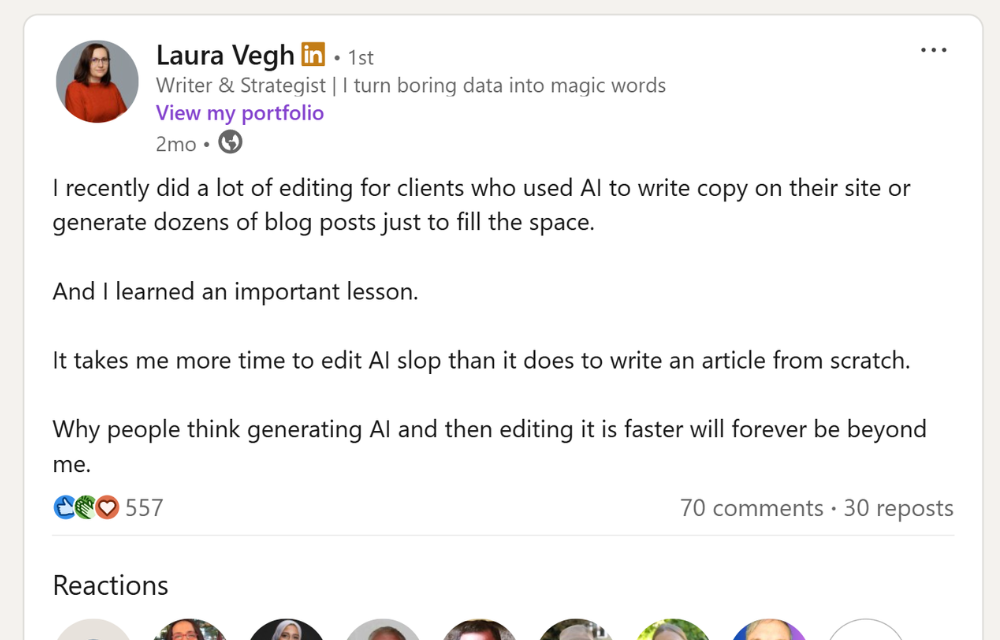
A post of mine went a tad bit viral on LinkedIn and got me some leads.
More recently, LinkedIn has become another source of freelance work for me.
At first, I followed the common advice about writing only what would interest potential clients. I tried creating educational posts designed around professional topics and assumed that this was the correct way to build a personal brand.
“Once I stopped trying to write what I thought clients wanted and started writing like myself, my content began attracting clients.”
Those posts brought me very little engagement and no clients.
Eventually, I decided to stop following the formula and write whatever I genuinely wanted to write. My reasoning was simple: I am a writer, so anything I publish can act as proof that I know how to write.
I began posting with more personality, including dark humour and commentary about trends in the writing and marketing industries.
That approach started bringing me clients.
One client who hired me for LinkedIn ghostwriting specifically mentioned that he liked the posts in which I wrote more naturally. He was attracted to the voice and personality of the work rather than a carefully engineered funnel strategy.
I would not claim that this approach works for everyone. Different businesses require different content strategies.
For me, however, authenticity became part of the strategy.
When I tried to sound like every other professional on LinkedIn, there was little reason to remember me. When I allowed my personality and sense of humour into the writing, my content became more distinctive.
The posts that tend to receive the strongest engagement are often those in which I make fun of trends in the industry, including trends related to AI.
They show how I think, how I write and how I approach the profession. That gives potential clients more useful information than a generic post containing advice they have already read many times.
You Don’t Have to End Up Stuck in the Same Field You Went to School For
I spent many years studying computer engineering.
I completed a PhD, became a researcher and teaching assistant, and followed a path that appeared likely to keep me in academia.
Today, I am a freelance writer.
That does not mean my education was wasted. The analytical skills, technical knowledge, and research experience I developed continue to influence my work every day.
“You do not have to remain in the field you studied. I am proof of that.”
The difference is that I no longer use those skills in the way I originally expected.
People often treat education as though it creates a permanent obligation. Once you have invested years in a particular subject, leaving that profession can feel like admitting that the investment was a mistake.
I do not see it that way.
Education gives you knowledge and skills. You can decide how to apply them.
Someone who studies engineering may become a researcher, product manager, consultant, technical writer or entrepreneur. Someone who studies psychology may work in marketing, user research or communications.
Careers are not always linear, and they do not need to be.
My own transition was possible because I paid attention to the parts of my work that I enjoyed. Research brought me back to writing. Writing for a technical company showed me that businesses needed people who could communicate complex ideas. Successful projects created referrals and helped me see that freelancing could become sustainable.
I did not abandon my old career and start from scratch. I carried the most useful parts of it into something new.
Changing direction can be difficult, especially when the new path seems less traditional or predictable. It may require building experience gradually, taking on projects alongside a full-time job, or experimenting with different ways to find clients.
But studying one subject does not mean you need to spend the rest of your life working in that field.
Your degree can be part of your story without determining the ending.