High-impact Recruitment Marketing Strategies to Attract Top Talent in 2026
Attracting top talent in 2026 will require more than offering competitive salaries and benefits. Companies need to create an engaging, mission-driven brand that resonates with candidates personally.
Startups and smaller companies must be especially strategic because they often compete against larger organisations with stronger brand recognition and more resources.
However, smaller companies can turn this challenge into an opportunity by highlighting their values, culture, and mission. This can make them more appealing to today’s purpose-driven workforce.
In this article, I share some of the recruitment marketing strategies companies can use to attract suitable candidates. These include making your mission a central recruitment hook, building an active presence on LinkedIn, recruiting through specialised communities, and using paid trials to assess candidates.
When combined, these strategies can help you create a brand that does more than sell a product or service. It can show candidates the impact they could make by joining your team.
What Does My Role at Arc.dev Involve?
I’m currently the Head of Marketing at Arc, a remote hiring platform where I have worked for five years.
We have a small marketing team consisting of three full-time employees and two freelancers. I like to say that we’re small but mighty.
Our work mostly focuses on growth marketing, although we also handle some brand and product marketing. We spend a lot of time creating content and implementing SEO strategies.
Our team is also active on LinkedIn, where we build our personal brands while strengthening Arc’s company presence. We do a little bit of everything.
What Are Some of the Biggest Hiring Challenges at Arc.dev?
Applications From Everyone, Everywhere
I have been leading the team for five years, and I have found that the benefits and drawbacks of remote hiring are often the same.
When you can hire anyone from anywhere, you will receive applications from people around the world.
The challenge is finding the needle in the haystack.
How do you identify the right match from such a large pool of candidates?
This issue exists whether you are hiring for an office-based or remote role. However, it becomes much more apparent when you recruit remotely.
How Do I Manage Receiving Too Many Applications?
Look for a well-written job description (JD)
Your JD needs to be really good.
And what I mean is you need to know exactly what you're looking for as a hiring manager. Make sure it answers these questions:
What is the job that needs to be done?
What are the specific tasks?
How are you going to track the right people for that role?
Know how to filter for the right people
Even though I'm the Head of Marketing, I think it's very important that I know how to do the role a little bit myself. It can't be a role I know 0% of, because that won’t help me hire well.
So usually, what we do is that when we test a new marketing channel, I'm personally out there testing. Let's say paid ads, for example, I will be part of the testing and experimentation phase so I can really be clear about whether is this channel good for us as a company.
And this really helps me gain some knowledge I need to filter for people with the right knowledge and expertise.
Showcase what it’s like to work with the team
Marketing and recruiting are very similar, actually. The marketing and HR departments should work more closely with one another because you need the marketing team to market your company culture.
The marketing team can help the HR department market things like:
What do you guys do?
What are you guys great at?
Do I check the right boxes of what it means to be the right fit boxes of what it means to be a good fit and the best talent on your team?

Myself, thefounder, and a few people in the company are really busy in this regard because we are very active in creating. This actually very helpful with recruiting because people can see what we're doing.
Not only can they see the work we're doing, but they can also decide if we’re cool and they’ll see signs of what it would be like to work with us over at Arc.
What Recruitment Challenges Do Startups Face When Attracting Talent?
Salary
Startups are competing with the big companies for the best talent. And it's especially true with engineers, right? And I know this because we’ve been helping companies find engineers for so long help.
Let's say you're a US-based startup, and you're competing with Amazon, Facebook, Netflix, all these companies that are getting the best talent. The best ones are going to the big companies with big salaries.
So they're not gonna win in terms of salary necessarily. They might offer something competitive, but it might not be the highest in the market.
Reputation
They're also not going to be as well-known, nor will they be as secure. Because a startup is not something that you can guarantee is gonna be around in say two or five years.
So startups basically have the issue of how do you then attract somebody to join a great engineer, a great marketer? How do you do it? So I think that comes down to helping sell the mission and the thing that you're doing.
Top Recruitment Marketing Strategies
1) How Can Startups Make Their Mission the Recruitment Hook?
We talked about LinkedIn as a social media marketing channel for that. But more than that, what LinkedIn really is, is a space where you can share - What is your mission? Why are you building this thing? Why is it cool? And how can you be part of that change?
“Show candidates they’ll make a real impact. People want to join a team where they can actually do work that matters.”
So I think that's the way that companies do win. It’s really just finding a way that resonates with the people. Look at the situation and ask yourself who are you targeting?
If this is a mission that resonates with those people you have a better chance to get them interested in your startup. Not everyone's gonna be your target audience or join your company, but those that do that's where you wanna focus.
2) Communicate Your Mission to Potential Hires
I am a strong supporter of using a platform where your company feels comfortable sharing content. For many companies, that platform will be LinkedIn.
Hiring managers are often told that they need to recruit someone within two weeks.
When a company has not spent time communicating its mission, it will not have the materials needed to market itself as an attractive place to work. The hiring manager may simply publish something on LinkedIn and hope for the best.
Founders should therefore build this into their strategy from day one. They should consistently share their mission and what they believe.
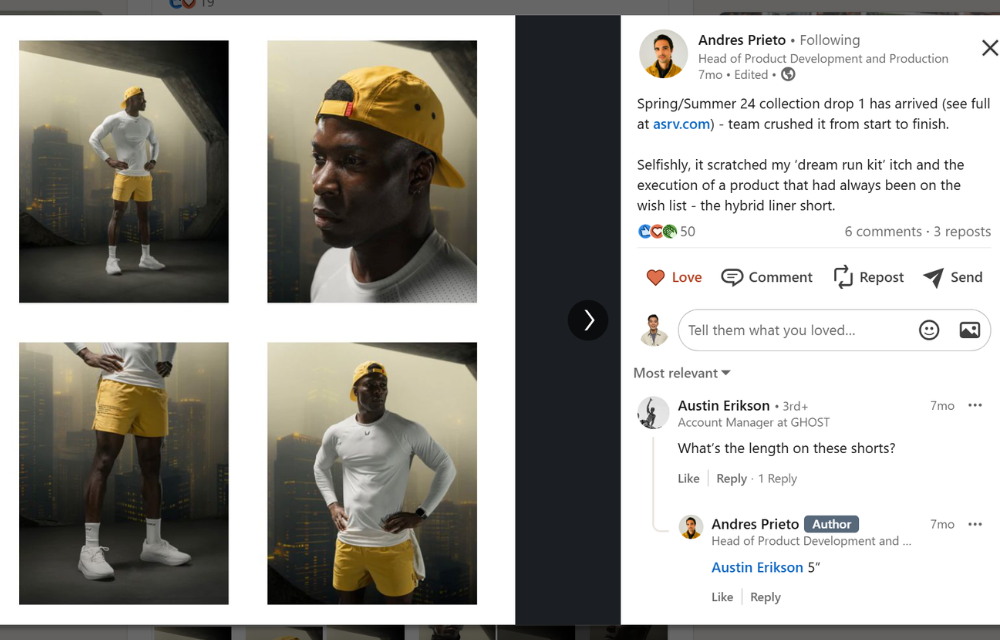
Activewear brand ASRV shares sketches of the brand’s collection on LinkedIn to talk about product launches and document the journey.
Founders may understand that this content is important, but it also needs to live somewhere accessible. Even an older Medium or LinkedIn post can become useful material when you need to explain the company’s mission to a candidate.
Recruitment should not be treated as something you only think about when you urgently need to hire someone.
It should be something you support continuously by sharing the deeper meaning behind your work.
We used this approach when hiring for Arc’s engineering team.

Arc’s post on Notion helped attract new hires to the engineering team.
I remember seeing a Notion post where our engineering team created a document explaining what they believed and how they worked.
Our Head of Engineering spent two or three hours polishing the document before publishing it. That piece of content has continued to help us attract engineering talent.
Several engineers who interviewed for positions on our internal team told us that the Notion article was what initially made them interested in working at Arc.
The content does not have to live on LinkedIn or your company blog. However, it must live somewhere people can discover it.
Potential candidates need to understand what your company believes and why they might want to work there.
3) Recruit Through Specialised Communities and Platforms?
When approaching hiring, companies sometimes use a spray-and-pray strategy.
LinkedIn will always be available, as will the major job boards in different countries. These platforms are often treated as the default places to advertise roles.

MKT1 has a dedicated job portal for B2B tech marketers.
However, when you want to match an ideal candidate with an ideal position, I recommend using specialised communities or talent platforms.
These platforms already contain the kinds of candidates you are looking for.
There are now many communities and newsletters aimed at specific types of professionals.
For example, I am a paid subscriber to MKT1, which has a job board specifically for B2B technology marketers.
If I were hiring a B2B marketer, I would consider advertising the position there because the audience already consists of B2B marketers.

Arc helps companies find remote talent globally.
I would prefer that over posting only on LinkedIn, where the vacancy would be shown to every type of marketer.
Specialised talent platforms can serve a similar purpose. Arc helps companies find remote talent globally and covers specific areas of specialisation, including B2B and e-commerce.
We also help companies hire in markets such as Latin America and the Philippines.
Companies should go to these specialised places because they provide a stronger initial source of candidates. Starting with a more relevant pool makes it easier to identify the best match.
4) Use Employee Referrals as Incentives
When companies are first starting, they may not have fully developed their culture.
However, once a company reaches around 20 employees, cultural fit becomes increasingly important.
I believe culture is everything for a company.
At that point, you may have developed a culture you value and want to find more people who will strengthen it.
This does not mean every hire must simply fit the existing culture. New employees can also be culture adds who bring different knowledge, perspectives, or experiences to the team.
When Arc had approximately 25 employees, we were finding it difficult to recruit like-minded people.
We introduced a referral programme that offered employees an Apple product of their choice if someone they referred was hired.
They could choose anything Apple sold.
We deliberately made the incentive more interesting than simply offering money.
The average cost was around US$2,000 to US$3,000. The programme worked well because three or four of our hires came through referrals.
That year, we only made around six or seven hires in total, so referrals accounted for a significant percentage of them.
Referral programmes work because employees often have peers and friends with similar values or abilities.
They can help companies find both culture fits and culture adds.
The company simply needs to create an incentive that is memorable and makes employees willing to use their social capital to introduce people to the organisation.
The incentive can also be money. The main objective is to keep the referral programme at the top of employees’ minds.
This also demonstrates why a company’s first hires are so important.
The initial team helps establish the culture, and its members may eventually refer the people who make up the future team.
5) Hiring freelancers
Let's say people sometimes have trouble with deciding if that person's a good fit. And I think there are two ways you can decide they're a good fit.
You can either hire them as a freelancer or you can do a paid assessment.
In terms of hiring a freelancer, you can hire them for a one-off one-month project. Say, for building out a content landing page. This lowers the barrier for each side.
For the company, if the freelancer doesn’t turn out to be a good fit, it’s easy to move on. For the freelancers, if the company culture is not aligned with their values, it’s easy for them to move on as well.
And if it's a good fit, you can then go ahead and convert them a full-time employee at your company.
6) Using paid trials
If you know for sure you need this hire to join your company as a full-time employee, you can give them a paid assessment to make sure that both sides are a good fit for each other.
You could only know by seeing someone's work.
And for them, they can also see what kind of work is expected of an employee at a company they are applying to. This prevents a misalignment of expectations.
We created these assignments, or let's say projects, based on the type of work we need help with internally. These projects will be made to feel as close as possible to the actual work they would be doing.
We then add them to a Slack channel with our team. So, say it's in the marketing team. You'd work with the other marketing teammates and be encouraged to ask questions. This way, we can learn a little bit more about you.
So we look out for things like how someone asks questions, do they even have questions, or do they just turn in their work and you just say nothing? At Arc, we want someone who's a little more collaborative and is asking questions along the way.
For our paid trials, we just try to like to mirror how it would be to work as much as possible and pay them for their time.
We did this when we hired our SEO strategist a few years ago. So back then we had an SEO strategist who had just started writing a few articles for us. We paid him for a few articles to kind of see how he's how he's going.
At that time, we were with an SEO agency and their performance was tapering off. We knew we wanted to bring it back in-house.
So here we are with this SEO freelancer whom we can vibe well with. AND, he's creating some great content! We ended up making the full-time hire because we felt more confident that he was the right the right person.
What Final Hiring Advice Would I Give Companies?
1) Hiring full-timers can be a bit more rigid
A few years ago, hiring another full-time employee might have been my default solution.
However, I now believe that relying too heavily on full-time hiring can make a team more rigid.
This is especially important in an uncertain market where venture capital funding has declined.
Hiring in the technology sector can become more difficult when budgets are limited. If companies insist on filling every position with a full-time employee, their options may be restricted.
Remote work has grown significantly in recent years, and I am excited about the possibilities created by freelance hiring.
2) Think about whether or not you really need a full-timer
Hiring has become more competitive, but companies also need to ensure that their teams remain resilient.
One way we have done that is by maintaining a smaller team.
When I need help with something that does not justify a full-time position, I am more likely to use freelance talent than I would have been in the past.
I encourage companies to pause before creating a new full-time role.
Ask whether you genuinely need a full-time employee.
Could you instead create an effective process and outsource the work to a freelancer?
Within our content team, for example, we use freelancers for some areas of execution while keeping the strategy in-house.
I am also strongly supportive of remote work. Our entire team is remote-first.
Companies should question what they need and decide what structure is most appropriate for them at that particular time.
They should also review that decision every year to ensure their teams remain as resilient as possible.
Marketing and Recruitment Are the Ultimate Combination for Attracting Talent
Recruiting top talent in 2026 will require more than traditional hiring practices.
Startups need to market their missions, cultures, and opportunities in ways that resonate with candidates.
Making the company mission a central selling point, building an authentic online presence, and using specialised networks can help businesses attract skilled professionals who share their goals and values.
These strategies do more than generate applications. They can help companies find people who are motivated to contribute meaningfully from the beginning.
Ultimately, recruitment in a competitive market is about creating an authentic and engaging employer brand.
With the right approach, smaller companies can compete against larger organisations and build teams capable of driving long-term growth.