
Is Blogging Dead: The Relevance of Blogs in the Age of AI
I’ve been working as a freelance writer for almost 10 years now, and during that time, I’ve watched company blogging change significantly.
There was a period when brands could publish relatively basic how-to articles, definitions and listicles and easily attract organic traffic. Many of those articles were produced primarily to target keywords, fill gaps in a content calendar and increase the number of pages on a website.
AI has changed that model. Someone looking for a straightforward answer can now ask ChatGPT or read an AI-generated search summary without visiting a company website.
That does not mean blogging is dead. It means that blogs need to offer a better reason to exist.
“Blogging is not dead. What is disappearing is meaningless content published simply to fill space.”
The companies that continue to benefit from blogging will be those that use their content to demonstrate expertise, answer meaningful customer questions, communicate human experiences, and build trust around their products.
A blog can no longer succeed simply because it contains the right keyword a certain number of times.
How AI Has Changed the Role of Company Blogs
Generic Informational Content Is No Longer Enough
Before generative AI became widely available, a company could build a large proportion of its blog around simple informational queries.
Articles such as “How to Do X,” “What Is Y?” and “Ten Ways to Improve Z” could attract readers who needed quick answers. These formats still have a place, particularly when they address a clear search intent, but they are no longer enough to differentiate a company.
AI can provide basic definitions, instructions and lists almost immediately. A generic article that simply rearranges information already available elsewhere gives readers very little reason to visit the original website.
In my view, successful blogs now need more human elements. These may include personal stories, original case studies, expert observations, empathy and experiences that an AI system cannot independently reproduce.
“When AI can answer the basic question, a blog needs to offer something more human—experience, empathy, stories or original insight.”
This is very easy to notice in industries such as travel. AI can give you a basic itinerary, a list of attractions, or a packing checklist. And it will do so without trying to sell you something or getting you to book through a certain website.
What it can’t do is tell you what small but amazing cafe you can find on a small, cobbled street, slightly off the beaten path. Or how kind the staff at the museum were when you realised you had read your ticket date wrong and missed your scheduled entry.
Bloggers in this niche need to reconsider what they can offer, placing a greater emphasis on recommendations and experience that an AI can’t generate from generic information alone.
Blogs Now Need to Demonstrate Expertise and Earn Trust
The role of a company blog has expanded beyond generating rankings and organic traffic. It has also become evidence that a company understands its field.
Imagine arriving on a company website and finding only one or two product pages, followed by a few short testimonials. Even when the product sounds promising, there is very little information available to help you decide whether the company knows what it is doing.
Now compare that with a website containing detailed guides, case studies and articles addressing problems adjacent to the company’s product.
The second company immediately appears more credible. Its content shows that there are knowledgeable people behind the business who understand their customers’ challenges.
That confidence can move someone towards scheduling a call, requesting a demonstration or considering a purchase.
“A company blog is no longer only a traffic channel. It is evidence that knowledgeable people are behind the business.”
A blog went from being a simple traffic channel to becoming a part of the evidence a potential customer uses to evaluate a company.
Human Experience Has Become a Competitive Advantage
One of the most important things a company blog can offer is a perspective shaped by real experience.
AI can combine information from different sources and produce a clear summary. What it cannot do by itself is interview a customer, experience a problem, implement a solution or reflect on what happened afterwards.
This creates opportunities for content based on first-hand lessons from company founders and employees, customer experiences, original research, internal data, expert opinions, failures and unexpected challenges.
These elements make an article harder to replicate because they originate from personal experience rather than from information that is already publicly available.
This does not mean every article needs to become an emotional personal essay. The amount of storytelling required depends on the subject.
For example, audiences reading about cybersecurity or energy-management software may primarily want a direct answer to a technical question. A personal story about experiencing a data breach might work in one article, but repeating that approach throughout the blog would quickly become unhelpful.
Someone searching for ways to protect company data generally wants practical steps, not an extended narrative. But each article can still tell your readers, “We’ve been in your shoes, we understand your problems” even if you don’t spell it out through a short personal essay in the middle of a tech guide.
Human content becomes valuable when the experience helps the reader understand or solve the problem.
Content Must Work for Both Readers and AI Systems
Modern blog content faces an interesting contradiction.
To stand out to human readers, an article often needs stories, personality, empathy and an original point of view. These elements provide something beyond what a user could receive from ChatGPT.
However, AI search systems often favour information that is presented in a direct and predictable way. Comparisons, lists, reviews and clearly structured answers can be easier for a language model to interpret and cite.
Companies therefore need to write for two audiences at the same time.
You need to organize you content clearly enough for search engines and AI systems to understand. Important questions should receive direct answers. Headings should describe the subject accurately, and key information should not be buried beneath an unnecessarily long introduction.
At the same time, the article should contain enough original expertise to make clicking through worthwhile.
“Content needs enough structure for AI to understand it, but enough originality to give people a reason to trust it.”
I do not believe companies must choose between AI-friendly writing and human writing.
A strong article can begin with a concise answer, explain the subject through a logical structure, and then introduce examples, experiences, opinions, and evidence that make the discussion more valuable.
Clarity helps machines understand the content. Experience gives people a reason to trust it.
Why Blogs Still Matter for SEO and Discoverability: Top Benefits of Having a Company Blog
Blogs Help You Rank for Specific Search Intent
Blog posts still give companies opportunities to appear in Google searches for the questions their potential customers are searching for.
A product page normally focuses on the product itself. It may explain features, benefits, pricing and use cases, but it cannot realistically answer every related question someone might have.
A blog allows a company to create separate resources for different stages of the customer journey.
These might include educational articles for people identifying a problem, comparisons for people assessing possible solutions, implementation guides for people considering a product, case studies for people looking for evidence and advanced tutorials for existing customers.
I experienced the value of this relatively early in my writing career. Around 2016, I worked with a company producing content about GDPR compliance.
We managed to rank its blog so prominently that it appeared above the European Commission for certain searches. People began contacting the company because they assumed that a website ranking above the Commission must be an important authority on the subject.
Search results have changed considerably since then, and rankings have become less predictable. Some of the more recent articles I've written still rank prominently for competitive industry keywords because they answered the reader's question in depth and demonstrated genuine expertise, as the one below.
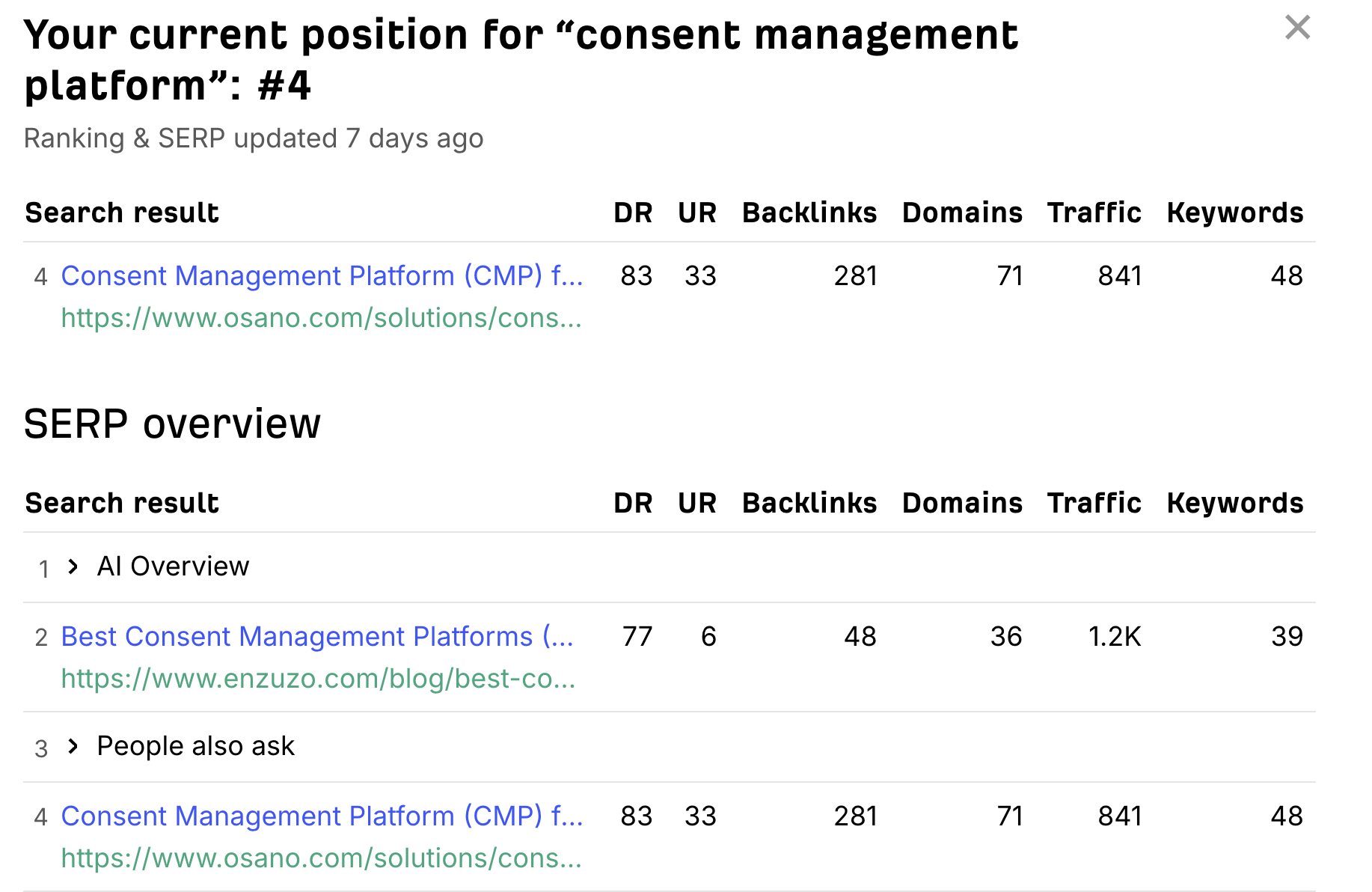
Keyword ranking data for a piece of content I wrote for Osano.
That’s because the basic principle remains relevant: every useful article creates another opportunity for a company to be discovered through a specific question.
Blog Posts Are Cited by LLMs to Support AI Search Visibility
Blogs are no longer discovered only through traditional blue links in search results. Their information can also be extracted, summarised and cited by AI systems. And with many search engines prioritising the AI overview, many see being cited there as more important than your SERP position.
Certain article formats naturally align with the types of questions people ask AI tools like product comparisons, recommended-tool lists, reviews, definitions, step-by-step instructions and answers to frequently asked questions.
These formats provide the clear informational answers that generative AI systems are designed to deliver.
And it creates another reason for companies to continue publishing useful content. Even when someone does not immediately visit the website, appearing as a cited or referenced source can introduce the company to a new audience.
However, you should not reduce every article to a collection of short, mechanical statements simply to pursue AI citations. AI visibility may help someone discover the brand, but the content still needs to persuade that person that the company is credible.
Blogs Help Companies Build Their Topical Authority
One article rarely establishes a company as an authority.
Authority develops when a business consistently publishes useful content around a connected group of subjects. Taken together, those articles demonstrate the scope and depth of the company’s knowledge.
For example, a cybersecurity company might publish content about data breaches, employee access, phishing, compliance, risk assessments and incident response.
Each article addresses a separate question, but collectively they reinforce the company’s expertise in protecting organisations.
This also helps potential customers understand where the product fits. Instead of encountering an isolated sales page, they can explore the problems the company solves, the principles behind its approach and the practical knowledge of its team.
The most effective topics are usually adjacent to the product rather than artificially attached to it. The goal is not to mention the company in every paragraph. It is to become genuinely useful within the wider subject area in which the company operates.
When visitors repeatedly find accurate and practical answers on the same website, they become more likely to see that company as a credible source.
Blogs Help Founders and Brands Build Their Online Reputation
Blogging can also shape what people discover when they search for a company founder, employee or brand.
During my interview with Nigel, he mentioned that he had searched for my name and found references to my freelance writing, academic background, interviews and other areas of work.
Search and AI systems were able to combine those references into a broader picture of who I was and what I had done.
A company blog can contribute to that footprint.
Articles associated with a founder or subject-matter expert provide search engines with more context about that person’s expertise. Interviews, guest contributions, case studies and opinion pieces can reinforce the same associations across different websites.
This is valuable because potential customers rarely evaluate a company using only the claims on its homepage. They may search for the founder, examine previous work, read interviews or look for evidence that the team has participated meaningfully in its industry.
The same principle applies to LinkedIn.
I initially tried following generic advice about posting only educational content designed to appeal directly to potential clients. That approach brought me very little engagement.
When I began writing with more personality, including humour and my own observations about industry trends, my posts started functioning as a more authentic writing portfolio. Some clients contacted me specifically because they liked the way I wrote.
I’m not saying that everyone should copy my approach. But the truth is a visible body of work helps people understand how you think, what you know and whether they want to work with you.
Blogs Provide Depth That AI Summaries Cannot
AI-generated answers are useful when someone needs a quick overview. They are less useful when a task requires detailed instruction, examples and context.
A short summary may explain what keyword research is. It is unlikely to replace a complete guide that walks someone through choosing a tool, evaluating search intent, filtering keywords, interpreting metrics and applying the results to a website.
Detailed articles can therefore remain valuable even when an AI system answers the initial question.
The AI-generated response may help someone understand the basics, while the original blog post helps them carry out the task.
This is especially relevant for complex products. Educational content can show readers how to solve a problem while naturally demonstrating how the product supports that process.
The article becomes more than a traditional advertisement because it gives the reader something they can apply. At the same time, it can introduce the product in a relevant context.
Companies should therefore consider which subjects genuinely require depth. A simple definition may not need 2,000 words. A technical implementation guide, decision framework or original analysis might.
Blogs Build Trust Before a Purchase
People may use AI to gather information, but they still want confidence in the people and companies they buy from.
This becomes particularly important when a purchase is expensive, technically complex or professionally risky. A potential customer may need more than a short answer before committing to a product or service.
Blog posts help reduce that uncertainty. They allow readers to assess whether the company understands their situation, whether its advice is practical and whether its approach appears credible.
“People may use AI to research their options, but they still want to buy from people they believe are credible.”
People still buy from people. They want to feel that the information guiding them towards a purchase was created or reviewed by someone who understands the subject.
This does not mean readers will carefully study every article before contacting a company. Often, the presence of a substantial and credible body of content is itself reassuring.
A strong blog communicates that the company has invested time in understanding its market and educating its audience. That trust can influence a sale even when organic traffic is no longer the only—or even the primary—measure of the blog’s value.
So, Is Blogging Dead?
No, I do not believe blogging is dead.
What is dying is the assumption that companies can publish large quantities of generic content and automatically receive rankings, traffic and customers.
AI can already answer many basic questions. There is little value in competing with it by producing another vague article that says exactly the same thing as every other search result.
Blogs remain relevant when they have a clear purpose. They can answer specific customer questions, provide the source material used by AI systems, demonstrate topical expertise, document original experiences and help people decide whether they trust a company.
The balance will vary by industry. Some audiences need concise technical instructions. Others value stories, opinions and personal experience. Many will need both at different stages of their journey.
The future of blogging is not so much about choosing between content written for search engines, AI systems or human readers but more about creating content that machines can understand and people still find worth reading.